

"Millennium PC: A Comprehensive Review"
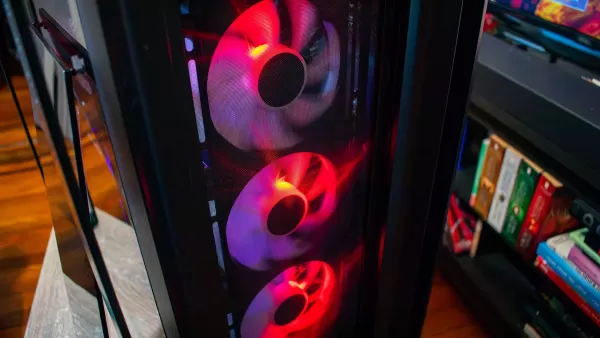
When shopping for a gaming PC, you're faced with several options. On one end of the spectrum are mass-produced prebuilt systems from major brands like Alienware, while on the other are high-end boutique builds that offer top-tier performance and extravagant design. The Origin Millennium falls somewhere in between—it's a powerful custom gaming PC built with standard components, without the extreme aesthetic flair you might expect from niche builders.
This is a premium system through and through, but it doesn’t rely on flashy or unconventional design to stand out. Instead, the Origin Millennium offers a clean, well-constructed build that you could technically replicate yourself—if you’re willing to deal with all the hassle of cable routing and component selection. That said, don’t be surprised if unboxing it involves lugging a heavy wooden crate up several flights of stairs.
Purchasing Guide
The Origin Millennium starts at $2,788, though that base model includes only an Intel Core i5-14600K and no discrete GPU—making it underwhelming for serious gaming at that price point. Fortunately, you can fully customize your configuration via Origin’s website, choosing from a wide array of available components. Just be aware: as performance increases, so does the cost.
Origin Millennium – Photos
 View 8 Images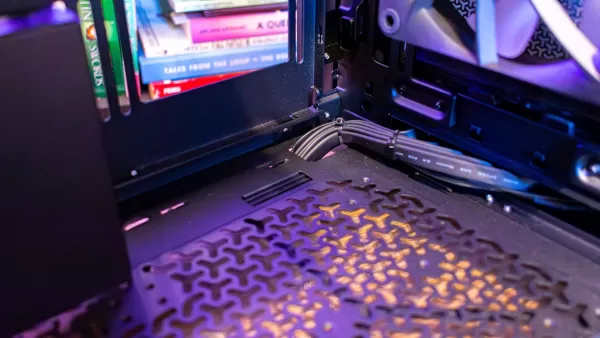
Design and Features
The Origin Millennium is undeniably large. It’s housed in a full-tower ATX case, further amplified by steel corner bars that give it an imposing presence. Empty, the case weighs 33 pounds—and that’s before installing high-end components like the MSI RTX 5090 Gaming Trio, a high-wattage power supply, and a 360mm AIO cooler. Factor in the sturdy wooden crate used for shipping, and transporting this system to your home—especially up multiple flights of stairs—will definitely require assistance.
Those metal corner braces, while visually striking, do present a minor inconvenience when accessing the interior. Specifically, the back-left bar obstructs removal of the glass side panel, potentially risking damage during initial setup. However, the bars are secured with Allen bolts and can be removed if needed.
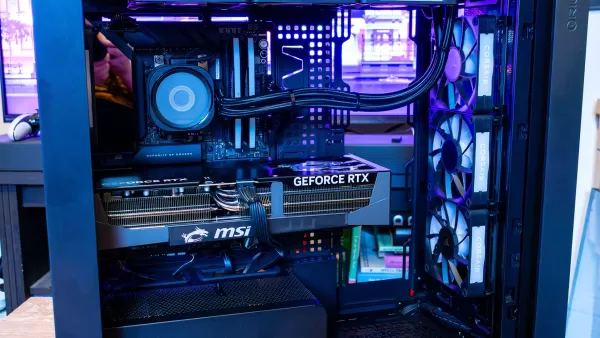
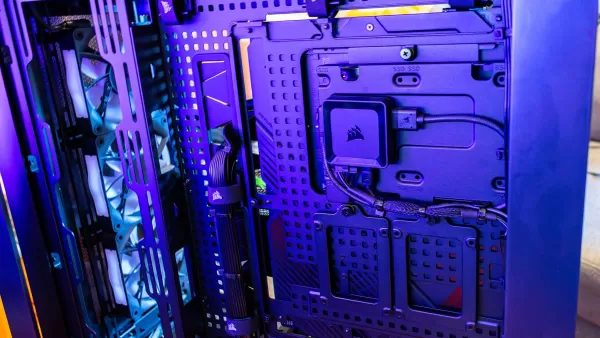
Inside, the build space is impressively roomy. Even with a massive 14-inch graphics card installed, there's ample room for airflow. Origin has also executed excellent cable management, hiding nearly all wiring behind the motherboard tray and neatly channeling them through grommets where required.
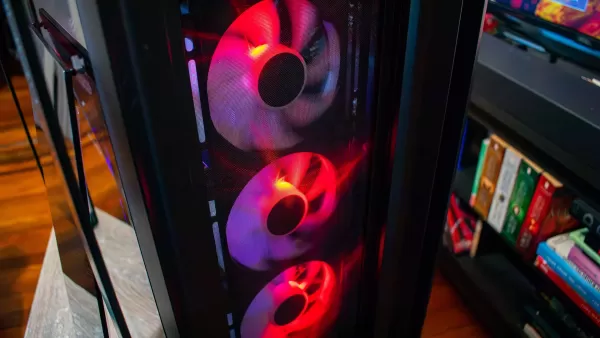
One unusual choice relates to the front intake fans. While three 120mm fans are included, their power cables (along with front panel connectors) are routed externally underneath the chassis. This minimizes internal clutter, but raises concerns about accidental snagging or damage.
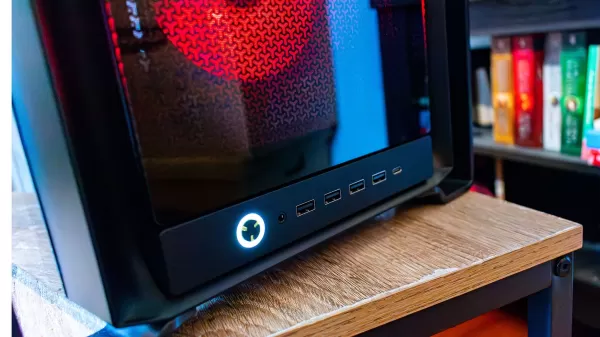
The front I/O panel gives you four USB-A ports and one USB-C port—plenty for most users. You also have the option to mount these ports and the power button either on the top or bottom of the case, depending on whether the system will sit on your desk or below it.
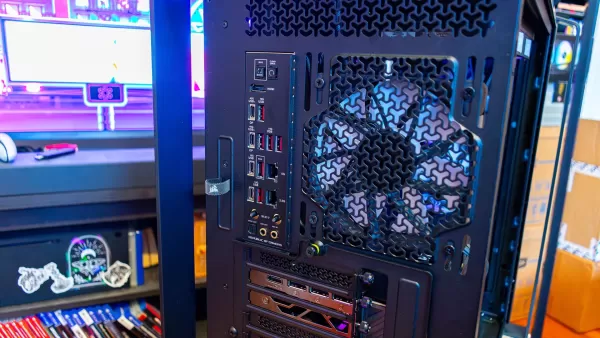
Equipped with an Asus ROG Crosshair X870E Hero motherboard, the rear panel offers generous connectivity: four USB-C ports, six USB-A ports, dual Ethernet jacks, HDMI for onboard graphics, and additional outputs from the RTX 5090 itself—three DisplayPort and one HDMI.
Custom Configuration Options
While the version tested is certainly overkill for most gamers, Origin allows full customization to suit your budget and needs. For example, a mid-range build featuring an AMD Ryzen 5 9600X, 32GB RAM, and an AMD Radeon RX 9070 XT delivers strong 4K performance at a more reasonable $3,392.
If you were to build that same system manually using retail parts, you’d likely spend around $2,397—meaning you're paying roughly $1,000 for Origin’s assembly service. For the high-end unit reviewed, the equivalent DIY build would come in at approximately $6,506, versus Origin’s $7,241 asking price.
In return for the premium, you gain Origin’s one-year warranty and lifetime technical support. They’ll even accept the system back for free upgrades—provided you cover the cost of new components. Additionally, the reinforced wooden crate used for shipping is unique to Origin and among the safest packaging methods for long-distance delivery, albeit quite heavy.
Ultimately, whether the extra cost is justified depends on your comfort level with building and maintaining PCs. If you'd rather avoid the hassle, Origin’s expertise and support make a compelling case.
Performance
The review unit was equipped with a potent combination: an NVIDIA GeForce RTX 5090 GPU, AMD Ryzen 7 9800X3D CPU, and 64GB of RAM—making it a powerhouse capable of handling any modern game at the highest settings.
During 4K testing, nearly every title exceeded 100 FPS without frame generation. Only Assassin’s Creed Shadows (75 FPS) and Metro Exodus (97 FPS) fell short, though both remained highly playable. Metro's result is particularly understandable given its ray-traced workload, which lacks modern upscaling technologies beyond DLSS.
With frame generation enabled in Assassin’s Creed Shadows, performance jumped to 132 FPS, though input latency increased from 33ms to 42ms. Still, such a change is unlikely to affect most players, especially in single-player experiences.
Cyberpunk 2077 performed similarly. At Ultra ray tracing settings with DLSS set to Performance mode, the Origin Millennium delivered 127 FPS with just 23ms of latency. With Multi-Frame Generation set to 4x, frame rates soared to 373 FPS while latency rose only slightly to 28ms—far beyond what most monitors can display.
Even without frame generation, 127 FPS in Cyberpunk 2077 is impressive. In fact, there are currently no games that would push this configuration to compromise on visual fidelity or resolution. Whether you play the latest AAA titles or demanding simulation games, the Origin Millennium handles them all with ease.
-
 Chess Online ♙ Chess MasterPlay chess online: challenge the AI, solve puzzles, and compete in multiplayer matches in Chess Master.Welcome to Chess Online: Master Chess & Puzzles – the premier platform to sharpen your skills, compete with players worldwide in Chess World Master
 -
 GoChess™GoChess - Smart Chess Board AppWelcome to GoChess – your interactive chess experience that combines innovative design with cutting-edge technology for remarkably realistic gameplay. Distance no longer limits your chess enjoyment! Challenge opponents
 -
 Space 1999Space 1999 - Memory, Stickers, Colors and Music Games for ChildrenFollowing the massive global popularity of "Oceano - Puzzles and Colors," we are excited to present:***** Space 1999 - Memory, Stickers, and Colors Games for Kids *****Meticulous atten
 -
 Magic Chess: Go GoMagic Chess: Go Go is an engaging online auto-battle strategy mobile game.Basic GameplayMagic Chess: Go Go is an 8-player competitive strategy experience. Assemble your team by recruiting heroes, assigning equipment, and positioning them tactically t
 -
 Neymar MemoryAn engaging memory game featuring your favorite football superstarHey there!Our latest release celebrates the legendary career of Neymar Jr.The game features 7 themed categories — «Childhood», «Santos»,«Barcelona», «PSG», «Brazil», «Miscellaneous» an
 -
 2021+ 일대일 고스톱 : 짜릿한 즐거움의 맞고Exciting New Twist on GoStop! 2021+ One-on-One GoStopLooking for a fresh and entertaining version of GoStop?Try 2021+ One-on-One Free GoStop!Experience thrilling matches with exciting new gameplay!A completely free game that delivers endless entertai
-
 Marvel Rivals Season 1 Release Date Revealed
-
 Sonic Racing: CrossWorlds Characters and Tracks Revealed for Upcoming Closed Network Test
-
 Honkai: Star Rail Update Unveils Penacony Conclusion
-
 Announcing Path of Exile 2: Guide to Sisters of Garukhan Expansion
-
 Ubisoft Cancels Assassin's Creed Shadows Early Access